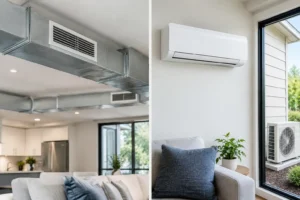
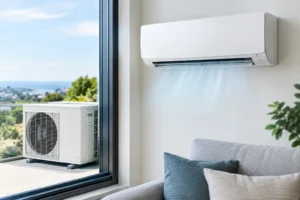
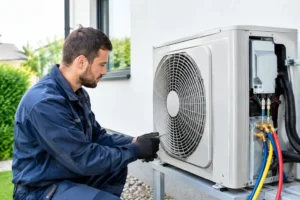
A meeting room that is too warm at 2pm, an empty flat being cooled all afternoon, or a shop unit running overnight can all add unnecessary cost to air conditioning. The phrase “smart aircon controls future” matters because the next generation of cooling is not simply about installing a more powerful unit. It is about giving property owners clearer, more useful control over the system they already rely on.
For homeowners and businesses in Essex, smart controls can make air conditioning easier to manage, more responsive to how a space is used, and less likely to waste energy. They are not a replacement for correct system design, professional installation or regular maintenance. Used properly, however, they make all three work harder for you.
Why smart aircon controls are the future
Traditional air conditioning controls do a simple job: set a temperature, select a mode and turn the system on or off. For a single room with predictable use, that may be all that is needed. The limitation appears when routines change, several rooms need different temperatures, or nobody is available to check the controller every day.
Smart controls connect compatible air conditioning systems to an app, central controller or building management platform. Instead of treating every hour in the same way, the system can follow a schedule, respond to occupancy, apply temperature limits and provide useful information about performance.
This is particularly valuable in commercial premises. A small office may need comfort in the main workspace from 8am to 6pm, while a meeting room is only used at certain times. A salon, retail unit or restaurant may have different cooling demands again. Running every indoor unit at full output all day is rarely the most sensible approach.
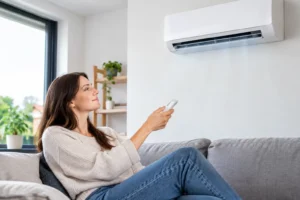
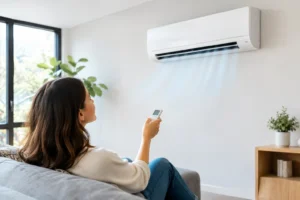
At home, the benefit is often convenience combined with better discipline. You can prepare a bedroom before bedtime, adjust settings while away, or make sure the system is not left running after everyone has gone out. The result should be controlled comfort rather than constant cooling.
What smart controls can do in practice
The right features depend on the air conditioning equipment and the property, but smart control normally centres on scheduling, zoning, remote access and monitoring.
Schedules that follow real routines
A schedule allows a system to start and stop around actual opening hours, working patterns or household routines. This sounds straightforward, but it prevents a common source of waste: conditioning unoccupied rooms because someone forgot to change a setting.
A sensible schedule should allow time for the room to reach a comfortable temperature without operating far earlier than necessary. In a well-designed system, this can be refined over time. If a room cools quickly, the start time can be reduced. If a sun-facing office gets warmer in the afternoon, its settings may need to differ from those used elsewhere in the building.
Room-by-room control
Zoning gives each room, or group of rooms, an appropriate level of control. It is useful in houses where bedrooms, living areas and home offices are used at different times. It is equally useful in commercial buildings, where an occupied office should not be governed by the needs of a stock room or unused meeting space.
Zoning is not a licence to set every room to a very low temperature. It works best when realistic setpoints are chosen and the system capacity has been matched to the building. A professional survey remains essential, particularly where several indoor units or larger commercial systems are involved.
Remote access without unnecessary call-outs
App-based access can be helpful for landlords, business owners and facilities managers who cannot always be on site. It allows authorised users to check whether a system is operating, alter a schedule or switch a unit off when plans change.
This can save time, but access should be managed carefully. Too many people changing temperatures throughout the day can create confusion and uneven comfort. For a business, it is usually best to give day-to-day staff simple controls while keeping advanced settings restricted to a manager or facilities contact.
Clearer information about performance
Some smart systems can show run times, temperature trends, filter reminders and fault notifications. That information can help identify patterns before they become expensive problems. For example, unusually long run times may point to a door being left open, blocked airflow, poor temperature settings or a system that needs inspection.
An alert is not a diagnosis. If a unit reports a fault code, it still needs assessment by an experienced engineer. Early visibility does, however, make it easier to arrange a repair before a minor issue turns into lost cooling during a busy period.
Lower energy use depends on good settings
Smart controls can reduce avoidable energy consumption, but they do not guarantee lower bills by themselves. Savings depend on how the building is used, the condition of the air conditioning system, insulation, solar gain, ventilation needs and the temperatures selected.
Setting a room to an extreme temperature will not cool it faster. It simply asks the system to run for longer and can make the space uncomfortably cold. For most occupied areas, a stable, sensible setting is more efficient and more pleasant than repeated large adjustments.
The same principle applies to heating functions on heat pump air conditioning. A smart schedule can prevent heating or cooling an empty property, but it must be set to suit the season and the people using the space. The technology should support good operating habits, not replace them.
Smart controls need the right system behind them
Not every existing air conditioning unit has the same smart capability. Some modern systems accept manufacturer-approved Wi-Fi modules or central controllers. Others may need an additional interface, while older equipment may offer limited options. Compatibility should always be checked before a control solution is chosen.
It is also worth considering Wi-Fi coverage. A controller cannot reliably communicate if the signal is weak where the indoor unit is installed. Larger sites may need a more considered network arrangement, particularly where several systems are being monitored from one location.
Security matters too. Use a strong password, keep apps and control hardware updated, and remove access when staff or tenants change. Remote control is useful only when the right people have it.
The role of maintenance in a smarter system
Smart controls are most effective when the air conditioning system is clean, correctly charged and operating as intended. Dirty filters, obstructed coils or developing faults can make a unit run longer than necessary, regardless of how advanced the controller may be.
Regular maintenance helps protect performance, indoor air quality and reliability. It also gives an engineer the opportunity to check whether schedules, airflow and room temperatures still suit the property. A business that has changed its layout, added staff or extended its opening hours may need its settings reviewed just as much as its equipment serviced.
For Essex Air Conditioning customers, the practical starting point is a professional assessment of the existing system and how the building is genuinely used. There is little value in paying for features that will never be used, but the right controls can make a noticeable difference to comfort and day-to-day management.
Is smart control right for your property?
Smart controls are often a strong choice for busy homes, rental properties, offices, retail spaces and any building with changing occupancy. They may be less urgent for a single room with a simple routine and a reliable manual controller. Even then, a basic timer or carefully set programme can still deliver much of the benefit.
The best approach is to start with the problem you want to solve. That may be wasted running time, rooms that are regularly too warm, difficulty managing multiple units, or a need to oversee a property remotely. From there, the suitable level of control becomes clearer.
A well-installed air conditioning system should make comfort feel straightforward, not add another task to the day. Smart controls are moving in that direction: helping Essex homes and businesses use cooling where it is needed, when it is needed, with less guesswork.