You usually notice air conditioning problems at the worst possible moment – when a bedroom will not cool before sleep, when a shop feels stuffy during trading hours, or when an office starts getting complaints by mid-morning. The top signs your AC needs service are often easy to spot early, but many property owners wait until the system stops working altogether. That delay can turn a manageable repair or routine maintenance visit into a more disruptive and expensive job.
A well-maintained air conditioning system should cool consistently, run efficiently and do its job without drawing attention to itself. If it starts behaving differently, that change matters. Some faults build gradually, while others appear suddenly, but both are worth dealing with promptly if you want to protect comfort, running costs and the life of the system.
Top signs your AC needs service before it breaks down
One of the clearest warning signs is weaker airflow. If the unit is switched on and running but the air coming through feels faint, uneven or slower than usual, something is not right. It could be as simple as a blocked filter, or it could point to a fan issue, a developing fault within the indoor unit or restrictions elsewhere in the system. In homes, this often shows up as one room staying warm while another gets reasonable cooling. In commercial settings, it may mean staff or customers are noticing hot spots in the space.
Poor cooling performance is another common sign. If the temperature is set correctly but the room still feels warmer than it should, the system may be struggling. There are several possible reasons for this, including low refrigerant levels, dirty coils, sensor issues or general wear. The key point is that air conditioning should not have to work excessively hard to achieve a normal temperature. If it does, service is usually overdue.
A noticeable increase in energy bills can also signal a problem. Air conditioning systems naturally use more electricity during warmer periods, but a sharp rise without any major change in usage is worth attention. When components are dirty, airflow is restricted or a fault is developing, the system often has to run longer to deliver less cooling. That means you pay more for poorer performance. For landlords and business owners especially, this can quietly add up over time.
Unusual noises are rarely harmless
Most air conditioning systems make some sound during normal operation, but those sounds should be familiar and fairly unobtrusive. If you begin hearing rattling, buzzing, clanking, hissing or clicking that was not there before, it should not be ignored.
A rattling noise can suggest loose parts or panels. Buzzing may point to an electrical issue, while hissing could indicate a refrigerant leak or pressure problem. Clicking is sometimes harmless at start-up or shut-down, but repeated or louder clicking can mean a control or electrical fault is developing. It depends on the system and the age of the unit, but a change in sound is one of the top signs your AC needs service because it often appears before a complete breakdown.
The same applies to vibration. If the unit seems to shake more than usual or the outdoor equipment is noisier than it used to be, it is worth having it checked. Small mechanical problems tend not to improve on their own.
Bad smells coming from the unit
Air conditioning should improve indoor comfort, not make the room smell worse. If there is a musty odour when the system starts up, that can indicate a build-up of dust, moisture or microbial growth inside the unit or drainage components. This is especially common where maintenance has been missed or filters have not been cleaned regularly.
A burning smell is more urgent. It may suggest overheating components, wiring issues or a problem with the motor. In that case, the safest approach is to switch the system off and arrange professional inspection as soon as possible.
For businesses, unpleasant odours can affect customers and staff straight away. For homeowners, they are often a sign that air quality is being compromised as well as cooling performance.
Leaks and moisture around the system
Any sign of leaking water or unexpected moisture around an indoor unit deserves attention. Sometimes this is caused by a blocked condensate drain, which can often be resolved during servicing before it leads to staining, damp patches or damage to nearby finishes. In other cases, leaks may be linked to frozen components or wider system issues.
If you suspect refrigerant rather than water, that is a more serious matter. Refrigerant problems reduce performance and can lead to compressor damage if left unresolved. You may not always recognise the difference immediately, which is why visible leaking around an air conditioning system should be assessed rather than guessed at.
This is particularly relevant in offices, retail premises and rental properties where small maintenance issues can quickly become complaints or property management problems.
Short cycling and constant running
An air conditioning system should run in normal cycles, not switch on and off every few minutes and not run endlessly without properly cooling the space. Both patterns can point to a problem.
Short cycling often means the system is under strain, incorrectly calibrated or affected by a fault in a key component. Constant running may suggest poor efficiency, undersized equipment, dirty filters or refrigerant issues. There is some nuance here, because longer run times can be normal during very warm weather or in high-heat commercial environments. Even so, if the behaviour is clearly different from usual, it is worth investigating.
This matters because abnormal cycling puts extra wear on the system. What starts as an efficiency problem can become a repair issue if left too long.
Poor air quality and rising dust levels
Many people think about air conditioning only in terms of temperature, but air movement and filtration matter too. If rooms feel stuffier, dustier or less comfortable when the system is on, servicing may be needed. Dirty filters, blocked coils and neglected units can all affect the quality of air circulating through the property.
In residential spaces, this may show up as more dust settling around the room or the unit blowing air that feels stale. In workplaces, it can affect comfort across the team, particularly in enclosed rooms or spaces with limited natural ventilation.
Routine servicing helps keep the system clean and working as intended. That does not mean every air quality complaint comes from the AC itself, but it is a sensible place to start when performance has declined.
Your system is overdue for maintenance
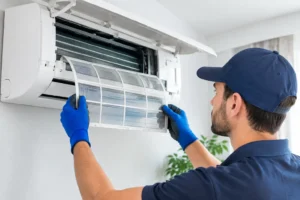
Sometimes the biggest sign is simply time. If the unit has not been serviced for a year or more, or you cannot remember when it was last checked, there is a good chance it is not operating at its best. Air conditioning systems need periodic attention even when they seem to be working reasonably well.
This is where many avoidable faults begin. Filters clog gradually, drainage components build up debris, electrical connections loosen and efficiency drops little by little. Because the decline is gradual, it is easy to miss until the system starts showing more obvious symptoms.
For homes, an annual service is often the sensible minimum. For commercial sites with heavier use, more frequent planned maintenance is usually the better option. It depends on how often the system runs, the type of environment and the demands placed on it.
When to act and when not to wait
There is a difference between monitoring a minor change and putting off service for too long. If airflow is slightly reduced or the system has become a little noisier, booking an inspection sooner rather than later can prevent larger faults. If there is leaking, a burning smell, poor cooling during active use or repeated tripping and restarting, waiting is harder to justify.
Older systems deserve especially close attention. As units age, parts naturally wear and efficiency tends to fall. That does not always mean replacement is the right answer. Often, professional servicing and targeted repairs can restore reliable performance. But the longer a problem is left, the fewer cost-effective options you may have.
Across Essex, we see the same pattern in both domestic and commercial properties: small warnings appear first, then performance drops, then the breakdown happens at the least convenient time. Acting early is usually the more practical and economical route.
If your air conditioning is cooling poorly, making unusual noises, leaking, running inefficiently or simply not feeling right, trust that change. A good system should deliver comfort quietly and reliably. When it stops doing that, a prompt service visit is often the simplest way to avoid a much bigger interruption later.