A shop can lose more than comfort when indoor temperatures rise. Staff become distracted, customers shorten their visit and certain products can suffer in prolonged heat. This Basildon retail aircon case study looks at the practical decisions behind a typical shop cooling project: assessing the space properly, selecting equipment that suits daily trading, and installing it with as little disruption as possible.
The scenario below is representative of the retail enquiries we receive across Basildon and wider Essex. Every premises needs its own survey, particularly where there are large glazed frontages, changing stock levels, restricted outdoor space or landlord conditions to consider. A free site survey is the point at which a sensible proposal begins.
The retail challenge
The shop in this example occupied a high-street unit with a customer area at the front, a small stockroom to the rear and a staff area beyond that. The large front window brought in useful daylight, but also significant solar gain during warm weather. With the entrance door opening frequently, cooled air escaped just when the system had the most work to do.
A domestic-sized unit would have been a false economy. It may have reduced the temperature close to one wall, but it would struggle to deal with the heat from lighting, people, equipment and sunlight across the whole sales floor. It could also run constantly, increasing energy use and shortening its working life.
The brief was not simply to make the premises cold. The business needed a comfortable, consistent environment for customers and staff during trading hours, without an installation programme that meant closing the shop for several days. Noise, appearance and ongoing running costs mattered just as much as cooling capacity.
Basildon retail aircon case study: survey and design
A proper survey considers how the shop actually operates rather than relying on floor area alone. The technician would measure the sales and back-of-house spaces, check ceiling height, note the window orientation and identify sources of heat. They would also ask when the premises are busiest, whether the door stays open and whether the system needs to provide heating in cooler months.
That information shapes the heat-load calculation and the system design. In this type of property, a wall-mounted split air conditioning system is often a practical option. One or more indoor units can serve separate areas, connected to an outdoor condenser positioned where it has sufficient airflow and can be serviced safely.
Zoning is often the better investment for retail units. The shop floor may need cooling throughout the day, while a stockroom may only require occasional temperature control. Providing separate control prevents the business from paying to condition unused areas. It also means staff can make sensible adjustments without affecting the customer-facing space.
There are trade-offs. A single larger indoor unit can reduce initial cost, but it may not distribute air evenly around shelving, displays and corners. Several units improve coverage and control, although they require more pipework and careful positioning. The right choice depends on the layout, budget and expected use, not on a one-size-fits-all recommendation.
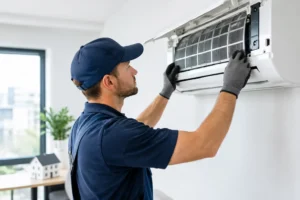
Indoor unit location is particularly important. Air should travel across the occupied space without blowing directly onto the till point or a queue of customers. The proposed positions should also allow filters to be removed easily for routine cleaning. An attractive shop fit-out deserves a tidy installation, so pipe routes, trunking and cable runs should be planned before work starts.
Planning around the building
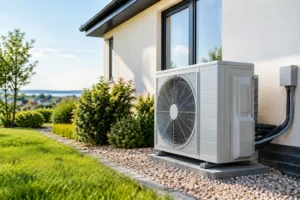
The outdoor unit needs more than a convenient empty wall. It requires clear space for ventilation, a stable mounting position and access for future maintenance. Its location should also take account of neighbouring occupiers, pedestrian routes, noise considerations and any building management requirements.
For leased retail premises, landlord approval may be needed before external equipment is installed. In some locations, planning restrictions or centre management rules can also affect condenser placement and visible trunking. Raising these questions early avoids delays after equipment has been ordered.
Keeping disruption under control
Retailers cannot usually afford an installation that takes over the shop floor during busy periods. The most effective approach is to agree a clear programme in advance. Work can often be arranged around quieter hours, with the more disruptive stages completed before opening, after closing or at a convenient point in the trading week.
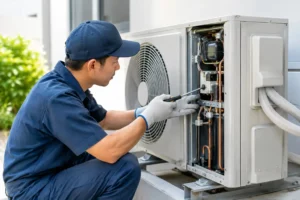
The installation team should protect displays and flooring, keep work areas tidy and communicate clearly with the person managing the premises. Indoor and outdoor units are mounted, refrigerant pipework and electrical connections are installed, and condensate drainage is routed correctly. The system is then pressure-tested, commissioned and checked across its operating modes.
Commissioning is not a formality. It confirms that the equipment is cooling and heating as intended, drains are operating correctly and controls are set up for the people who will use them. The shop manager should be shown how to adjust temperatures, use schedules and recognise a warning that needs attention.
A system that is technically sound but poorly handed over can still lead to wasted energy. If staff repeatedly turn settings down to their lowest point, the premises can feel uncomfortable and the unit will work harder than necessary. Sensible setpoints and a straightforward operating routine are usually more effective.
Results that matter to a retailer
The clearest benefit of a correctly specified system is a more stable shop environment. Rather than relying on portable fans or hoping the weather changes, the business has controllable cooling when summer temperatures build. Modern air conditioning can also provide efficient heating during shoulder seasons, which can be useful where existing heating is slow or expensive to run.
For staff, a more comfortable workspace supports concentration during long shifts. For customers, it makes browsing easier and can help the premises feel more welcoming when the high street is hot. This is not a guarantee of increased sales, as footfall and trading performance depend on many factors, but indoor comfort is a part of the experience a retailer can control.
There can be protection benefits too. Heat-sensitive stock, electronics, cosmetics, packaged food and display materials may all be affected by excessive temperatures. The exact requirement depends on the product and manufacturer guidance, but temperature control gives the business greater consistency than opening windows and using fans alone.
Energy costs still need realistic consideration. Air conditioning uses electricity, and a poorly designed or neglected system will cost more to operate. Correct sizing, inverter-driven equipment, separate zones and sensible controls all help. So does avoiding unnecessary cooling when the premises are empty. A survey should balance the initial installation price against expected performance over the life of the system.
Maintenance protects the investment
Once the system is operating, maintenance becomes the difference between dependable comfort and avoidable call-outs. Filters collect dust, drains can block and outdoor coils are exposed to dirt and debris. These issues can reduce airflow, impair efficiency and eventually cause leaks or faults if left unattended.
For a retail unit, planned maintenance should fit around trading and include cleaning, operational checks and an inspection of key components. The frequency depends on use, footfall and the environment. A small boutique with limited hours will have different needs from a busy convenience shop with doors opening all day.
Prompt repair support also matters. If a unit begins making unusual noise, has weak airflow, leaks water or shows a fault code, it is better to arrange an inspection early than continue operating it in the hope that the issue resolves itself. Minor faults are often less costly to address before they affect other components.
A practical next step for Basildon shops
The value of this Basildon retail aircon case study is not in copying one equipment choice for every shop. It is in recognising that comfort, appearance, trading hours, energy use and future maintenance all need to be considered together. Essex Air Conditioning can assess the premises, explain suitable options clearly and provide a no-obligation quote based on the requirements of the space.
If your shop becomes difficult to work or browse in during warm spells, arrange a survey before the next period of hot weather. A well-planned system gives you time to make the right decision, rather than rushing into a solution when customers and staff are already feeling the heat.