A south-facing bedroom that becomes unbearable by mid-afternoon, a stuffy office where productivity falls in July, or a cold garden room in January all raise the same question: heat pumps versus aircon, which is the better answer? The short version is that the terms often overlap. Most modern split air conditioning systems are air-to-air heat pumps, meaning they can cool a room in summer and provide efficient heat when temperatures drop.
The best choice depends less on the label and more on what you need the system to do. If your priority is controlled cooling with useful heating in selected rooms, air conditioning is often the practical route. If you are replacing a whole-home wet central heating system, an air-to-water heat pump may be more appropriate. Understanding that distinction can prevent an expensive mismatch between system and property.
Heat pumps versus aircon: the key difference
A heat pump moves heat rather than creating it in the way a traditional electric heater does. In heating mode, it draws available heat from outdoor air and transfers it indoors. In cooling mode, it reverses that process, removing heat from inside and releasing it outside.
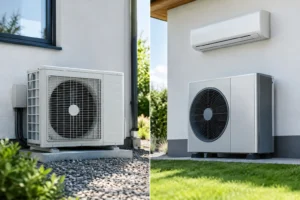
This is exactly how a modern wall-mounted split air conditioning unit works. It has an outdoor condenser and one or more indoor units, and it can usually heat as well as cool. It is therefore an air-to-air heat pump, even though most homeowners and businesses call it aircon.
When people refer to a “heat pump” in the UK, however, they are often talking about an air-to-water system. This connects to radiators, underfloor heating and sometimes a hot water cylinder. It is designed to heat water for a property’s central heating system, not to deliver chilled air into rooms during hot weather.
That difference matters. An air-to-water heat pump can be an excellent low-carbon heating option in a suitable home, but it does not normally provide the direct, dependable room cooling that a split air conditioning system offers. Air conditioning gives you fast temperature control where you spend time. An air-to-water system addresses a broader central-heating requirement.
When air conditioning is the better fit
For many Essex homes, a reversible air conditioning system is the most direct solution to summer overheating. Bedrooms, loft conversions, home offices, conservatories and open-plan living areas can all retain significant heat, particularly in properties with large glazed areas or limited cross-ventilation.
A correctly sized split system cools the occupied space quickly, removes excess humidity and maintains a chosen temperature rather than simply pushing warm air around. In heating mode, it can also provide economical warmth during spring and autumn, or reduce reliance on central heating in a frequently used room.
This makes air conditioning particularly useful when you do not want to replace your existing boiler and radiators. You can retain your main heating system for the whole house while adding targeted comfort to the rooms that need it most. A multi-split system can serve several rooms from one outdoor unit, while larger homes and commercial premises may benefit from a more tailored configuration.
For businesses, the case is often even clearer. Offices, salons, retail spaces, clinics, server rooms and hospitality settings need a comfortable environment in every season. Air conditioning provides both cooling and heating without waiting for a full building-wide wet heating system to respond. Zoned controls also allow different areas to be set according to their use and occupancy.
When an air-to-water heat pump makes more sense
An air-to-water heat pump is worth considering when your main goal is to replace or substantially reduce reliance on a gas, oil or electric boiler. It supplies low-temperature water to a property’s heating circuit and can be highly efficient when the building is well insulated and the heat emitters are correctly designed.
The system needs careful planning. Because it generally works best with lower flow temperatures than a boiler, some properties need larger radiators, underfloor heating, improved insulation or changes to pipework. Space may also be required for a hot water cylinder. It is not simply a like-for-like boiler swap.
This approach can suit homeowners undertaking major renovation work, building an extension, or planning a full heating upgrade. It may also suit commercial sites with an established wet heating network and a clear strategy for reducing carbon emissions.
The trade-off is that it is a more involved project than fitting room air conditioning. It also does not automatically solve summer comfort. Some air-to-water systems can offer cooling with suitable fan coil units or underfloor systems, but this must be designed in from the outset and will not feel the same as dedicated air conditioning in a warm bedroom or busy office.
Compare running costs, not just installation costs
Both types of system use electricity, but efficiency is measured by the amount of heating or cooling delivered for the electricity consumed. In the right conditions, a heat-pump-based system can provide several units of heat for each unit of electricity used. Actual performance depends on outdoor temperatures, system design, insulation, controls and how the system is operated.
With air conditioning, costs are influenced by the number of rooms, the unit’s efficiency rating, the temperature you choose and the condition of the property. Setting a sensible target temperature and keeping doors and windows closed while cooling makes a noticeable difference. In winter, using aircon heating for a single occupied room can be more cost-effective than heating an entire house, although it is not necessarily the right replacement for whole-home heating on the coldest days.
With an air-to-water heat pump, installation costs can be higher because the project may involve radiators, a cylinder, electrical works and heating-system alterations. Its value is strongest when it is part of a properly assessed heating strategy, rather than an impulse purchase based solely on predicted savings.
Avoid choosing based on a single headline figure. A professional survey should consider room sizes, heat loss, insulation, glazing, occupancy, outdoor-unit position and how you use the building. An undersized aircon unit will struggle on very hot days, while an oversized system may cycle inefficiently and make a room feel less comfortable.
Installation considerations for Essex properties
External space and practical positioning are central to both options. Outdoor units need good airflow, a secure base and consideration for neighbours, access and noise. Indoor air conditioning units should be located to distribute air effectively without blowing directly onto where people sleep, work or sit for long periods.
Many air conditioning installations are straightforward, but every property is different. A listed building, leasehold flat, restricted external wall, awkward pipe route or limited outdoor space may affect the proposed design. Early advice is especially useful for landlords and commercial property managers, where tenant comfort, access arrangements and planned maintenance all need consideration.
Planning rules and permissions can also vary by property and installation type. A competent contractor will assess the site, explain any constraints and recommend a system that is realistic for the building, rather than forcing a standard solution into an unsuitable space.
Maintenance protects performance
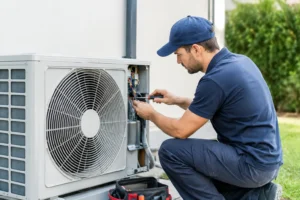
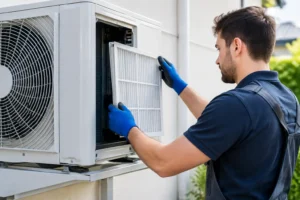
Neither aircon nor a heat pump should be treated as fit-and-forget equipment. Filters, coils, drainage and electrical connections need routine attention to keep the system efficient, hygienic and reliable. In air conditioning units, clean filters also support better airflow and help maintain indoor air quality.
Commercial systems may need planned maintenance that reflects their use, particularly where equipment runs for long periods or cooling is business-critical. For homeowners, regular servicing helps spot small issues before they become inconvenient breakdowns during a heatwave or cold spell.
Choosing the right system for your property
Choose air conditioning if you want assured cooling, room-by-room heating and a relatively focused installation. It is often the strongest option for bedrooms, living spaces, home offices and business premises where year-round temperature control matters.
Choose an air-to-water heat pump if you are reviewing your entire central heating arrangement and your property is suitable for a low-temperature wet heating system. It is a long-term heating decision that deserves a full heat-loss assessment and clear design proposal.
In some properties, the right answer is both: an air-to-water heat pump for central heating and hot water, with air conditioning in rooms that overheat. There is no benefit in treating the technologies as rivals when they can solve different comfort problems.
A free, no-obligation survey gives you the clearest route forward. Essex Air Conditioning can assess the rooms or workspaces causing concern, explain the practical options and recommend a system built around your comfort, property and budget.