A warm shop floor, stuffy treatment room or overheated office is not a minor inconvenience. It affects how customers feel, how long staff can concentrate and, in some cases, how well equipment performs. The right aircon for small businesses gives you dependable temperature control without turning energy costs or installation work into an unnecessary headache.
For most smaller premises, the best answer is not the largest unit available. It is a properly surveyed system that suits the room, daily footfall, heat-producing equipment and the way the business operates. That is where professional advice makes a measurable difference.
Why air conditioning matters in a small business
Comfort has a direct effect on the experience you provide. A client waiting in a warm salon, a customer browsing a humid retail space or an employee working at a hot desk will notice the environment before almost anything else. During warmer spells, opening windows is often not enough, particularly in busy locations, rooms with large south-facing windows or premises near traffic.
Air conditioning also does more than cool. Modern systems can provide efficient heating during colder months, helping businesses maintain a consistent indoor temperature throughout the year. Many units filter circulating air too, which can improve the feel of a dusty or enclosed space when maintained correctly.
There are practical limits. Air conditioning is not a replacement for suitable ventilation where your premises need fresh-air provision, such as commercial kitchens or high-occupancy rooms. A professional survey should identify whether cooling, ventilation or a combination of both is needed.
Choosing aircon for small businesses
The starting point is understanding the space rather than choosing a unit based on floor area alone. Two rooms of the same size can require very different cooling capacity. A quiet back office with blinds will behave differently from a sun-facing shop with refrigeration, computers, lighting and a regular flow of customers.
A competent installer will assess the room dimensions, ceiling height, insulation, glazing, orientation and likely occupancy. They should also account for internal heat sources, including ovens, servers, display lighting and machinery. This avoids the two common and costly mistakes: undersizing a system that cannot keep up on hot days, or oversizing one that cycles on and off too often.
Split systems for offices, shops and treatment rooms
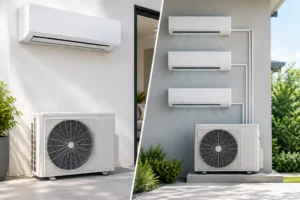
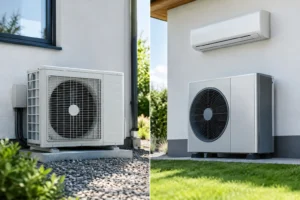
For many small businesses, a wall-mounted split system is the most practical option. It consists of an indoor unit and an outdoor condenser, connected by discreet pipework. It is efficient, quiet and well suited to individual offices, reception areas, small retail units, studios and consulting rooms.
If several rooms need independent temperature control, a multi-split system may be a better fit. One outdoor unit can serve multiple indoor units, allowing each room to be set separately. This can be useful for a small office with meeting rooms, or a clinic where treatment rooms are used at different times.
The trade-off is that multi-split installations are more involved to design and install. In some premises, separate single-split systems may provide simpler future servicing or greater flexibility. The right choice depends on the building layout, external space and how often each room is occupied.
When a larger commercial system is justified
Open-plan offices, busy salons, gyms and larger retail areas may need a more substantial solution, such as cassette units fitted into a suspended ceiling or a ducted system. These can distribute conditioned air more evenly across a wider area and are often less visually prominent than several wall-mounted units.
They are not automatically the best choice. Ceiling space, access for maintenance and the cost of building work all need consideration. A smaller, well-planned system can be the better investment where the premises are compact or where only certain areas need cooling.
Plan the installation around your daily operation
A good air conditioning installation should support the business without disrupting it. Before work begins, decide where indoor units can deliver air effectively without blowing directly onto desks, treatment beds, tills or seating areas. The outdoor unit needs sufficient airflow, a secure mounting position and sensible consideration for neighbouring properties.
Noise matters as well. Quality modern equipment is generally quiet, but placement is still important. An outdoor condenser next to a neighbour’s bedroom window, or an indoor unit above a quiet consultation area, can create avoidable problems. Your installer should discuss these points before recommending a final layout.
Drainage and electrical supply are equally important. Indoor units remove moisture from the air while cooling, so condensate must be discharged safely. Electrical work must be correctly specified for the equipment and site conditions. These details can be easy to overlook in a rushed quotation, but they affect reliability and the quality of the finished installation.
For leasehold premises, check the terms of your lease before installation. Landlords or managing agents may require written consent, especially for external equipment, pipework routes or alterations to the building fabric. Planning restrictions can also apply in particular locations or to listed buildings. Resolving these points early prevents delays once the system has been selected.
Keep running costs under control
Air conditioning does use electricity, but an efficient, correctly sized system should be viewed against the value it brings: a more comfortable workplace, better customer experience and the ability to heat and cool with one system. Modern inverter technology adjusts output to match demand rather than simply switching between full power and off, which helps control consumption.
The way the system is used has a major effect on cost. Set a sensible target temperature rather than making the room excessively cold. In summer, a setting around 23-25°C is often comfortable for most workplaces, although the right setting will vary by activity and occupancy. Keep doors and windows closed while the system is running, use blinds to reduce solar gain and programme operating times around opening hours.
Do not ignore the condition of the building. Air escaping through poorly sealed doors, unshaded glass or an uninsulated roof makes any system work harder. Air conditioning performs best when it is part of a practical approach to managing heat in the premises.
Maintenance protects performance and air quality
A new system will not stay efficient by itself. Filters collect dust, indoor coils can become dirty and drainage lines need checking. Without maintenance, airflow can reduce, energy use can rise and unpleasant smells may develop. In a customer-facing business, these are problems you want to prevent rather than explain.
Regular professional maintenance usually includes cleaning filters and coils, checking refrigerant operation, testing electrical components, inspecting the condensate drain and confirming that the system is delivering the expected temperatures. The frequency depends on how hard the equipment works and how clean the environment is. A busy salon, workshop or food-adjacent area may need more frequent attention than a lightly used office.
Staff can help between visits by keeping the area around indoor and outdoor units clear, reporting unusual noises or water leaks promptly, and not blocking airflow with stock, furniture or displays. Small issues are typically quicker and less costly to resolve before they lead to a breakdown.
What to expect from a professional survey
A free survey is your opportunity to get specific answers rather than a generic recommendation. The contractor should inspect the premises, ask how each area is used and explain suitable equipment options in plain language. You should receive a clear quotation covering the proposed units, installation scope, controls and any required electrical or building work.
It is reasonable to ask about expected noise levels, warranty arrangements, maintenance requirements and how the system will be positioned. Be cautious of quotations based solely on photographs or a rough room measurement where the site has obvious complications. A lower initial price can become poor value if capacity, drainage, access or external placement has not been properly considered.
For businesses across Essex, Essex Air Conditioning provides surveys and straightforward advice designed around the premises, budget and day-to-day requirements. The aim is to specify equipment that performs reliably, not simply to sell the biggest system.
A well-chosen air conditioning system should fade into the background: staff stay comfortable, customers feel welcome and the temperature remains under control when the weather changes. Arrange a professional survey before the busiest warm period, and you can make the decision calmly rather than when an uncomfortable workplace forces a rushed fix.