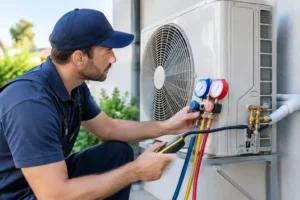
When your system starts blowing warm air in the middle of a busy week, the question becomes urgent very quickly – should you repair or replace air conditioner equipment, or are you about to spend money in the wrong place? For homeowners, landlords and business premises across Essex, the right answer usually comes down to cost, age, reliability and how much disruption you can afford.
There is no single rule that fits every system. A minor electrical fault on a fairly modern unit is very different from a failing compressor on an older system that has already had several callouts. The aim is not just to get the air conditioning running again today, but to make a sensible decision for the next few years.
How to decide whether to repair or replace air conditioner systems
The first thing to consider is the age of the unit. Most well-installed air conditioning systems can give many years of dependable service when they are maintained properly, but age still matters. If your system is relatively new and the fault is isolated, repair is often the most cost-effective choice. If it is getting towards the latter part of its working life, replacement may offer better value than another round of repairs.
The type of fault matters just as much as age. A blocked drain, worn capacitor, failed fan motor or control issue can often be repaired without turning the job into a major expense. On the other hand, compressor failure, recurring refrigerant leaks, coil damage or multiple component faults can push repair costs high enough to make replacement the more practical route.
Running costs should also be part of the decision. Older systems are usually less efficient than newer models, and that difference shows up in your energy bills. If the unit still works but struggles to cool the space properly or runs for longer than it used to, replacing it can sometimes reduce monthly costs enough to justify the investment.
The signs a repair still makes sense
A repair is normally the right call when the system has been reliable up to this point and the issue is clearly identifiable. If the air conditioning has been serviced regularly, is not excessively old and has not needed repeated attention, fixing the fault is often the straightforward option.
This is especially true where comfort needs are immediate. A shop, office, server room or treatment room may need the system back up and running quickly, and a targeted repair can restore performance with minimal disruption. For many domestic systems, the same applies – if one part has failed but the rest of the unit is in good condition, replacing the whole setup would be unnecessary.
Repair can also make sense if you are planning other property works and do not want to commit to a new installation yet. In that case, a sensible short-term repair may buy you time until the wider project is ready.
That said, a good contractor should be honest about limits. A repair should restore confidence in the system, not simply postpone another fault by a few weeks.
When replacement is usually the better investment
There comes a point where repairing an ageing air conditioner stops being cost-conscious and starts becoming false economy. If the system breaks down regularly, struggles to maintain temperature, uses outdated refrigerant or has become noisy and inefficient, replacement is often the better long-term move.
This is particularly relevant for landlords and commercial property operators. Ongoing callouts create inconvenience for tenants, staff and customers, and repeated breakdowns can become more expensive than installing a dependable new system. There is also the hidden cost of uncertainty. If every warm spell brings another fault, the system is no longer doing its job properly.
A replacement also gives you the chance to correct sizing or design issues. Some older systems were not ideally matched to the room they serve. You may have hot and cold spots, poor airflow or a unit that runs constantly without reaching the desired temperature. A properly specified replacement can solve those problems rather than patching around them.
Repair or replace air conditioner units based on cost
Cost is usually the deciding factor, but it should be looked at in the right way. Many people focus only on the immediate repair bill versus the installation quote. That is understandable, but it can be misleading.
A cheaper repair is not always the cheaper option over time. If the repair keeps an inefficient or unstable system going for another year, only for a second and third issue to follow, the total spend can quickly overtake what a replacement would have cost. By contrast, a well-judged repair on a sound system can save a substantial amount and extend useful life without compromise.
A practical way to look at it is this: if the repair cost is significant in relation to the age and condition of the system, pause before approving the work. Ask whether that money is restoring real value or simply delaying replacement. A trusted engineer should be able to explain that clearly, without pushing you in either direction.
Factors people often overlook
One common oversight is maintenance history. A system that has been serviced properly is easier to assess and often a safer candidate for repair. If filters have been neglected, coils are dirty and faults have been left too long, the damage may run deeper than the original symptom suggests.
Another is refrigerant type. Older systems may use refrigerants that are less practical or more expensive to work with now. In that case, even a repairable fault can become less attractive from a cost and future-proofing point of view.
Noise and comfort should not be ignored either. Some customers put up with poor airflow, rattling, inconsistent temperatures or unpleasant smells because the unit technically still runs. If comfort is poor and confidence is low, replacement may be justified even before total failure.
For businesses, downtime matters as much as equipment cost. An unreliable system in a retail unit, office or hospitality setting can affect staff comfort, customer experience and day-to-day operations. The cheapest repair is not always the best business decision if it leaves risk hanging over the premises.
Why an expert assessment matters
This decision is difficult because the answer depends on the full condition of the system, not just the visible symptom. Warm air from the indoor unit could be a simple control fault, a refrigerant issue, a failing compressor or something else entirely. Without a proper inspection, it is easy to make the wrong call.
An experienced contractor should look at performance, age, efficiency, repair history and the condition of key components before recommending the next step. They should also take your priorities into account. A homeowner may want the lowest sensible outlay today. A facilities manager may place more value on reliability and predictable running costs. Neither approach is wrong, but the recommendation should fit the situation.
This is where local, straightforward advice is worth a great deal. Essex Air Conditioning works with both domestic and commercial customers, and that practical experience matters because the right answer in a family home is not always the same as the right answer in a business premises.
A simple way to think about the decision
If the unit is fairly modern, has been dependable and needs one sensible repair, repairing is often the right move. If it is older, inefficient, increasingly unreliable or facing a major fault, replacement is usually the stronger investment.
If you are stuck between the two, ask yourself a more useful question than “Can it be repaired?” Most systems can be repaired in some form. The better question is “Is this repair worth doing for the life, performance and reliability I will get in return?”
That shift in thinking usually brings clarity. Air conditioning should make a property more comfortable and easier to manage, not become a repeating source of cost and frustration.
The best decision is the one that gives you confidence when the temperature rises – not just for this week, but for the seasons ahead.