A home office that reaches 27°C by mid-afternoon is not a minor inconvenience. It affects concentration, sleep after work and the performance of laptops, monitors and other equipment. The best aircon for home offices is usually a quiet wall-mounted split system, correctly sized for the room and professionally installed. It delivers controlled cooling without the noise, clutter and compromises that often come with portable units.
That said, the right choice depends on the room itself. A converted box room with one occupant needs something very different from a garden office with full-width glazing, multiple screens and regular client calls. Choosing well starts with how you use the space, not simply buying the highest-output unit available.
Why a dedicated home-office system is worth considering
Fans move warm air around the room. Portable air conditioners can offer short-term relief, but they need a hose through a window or wall, take up valuable floor space and can be distracting during calls. They are also typically noisier than a fixed system because the compressor is inside the room with you.
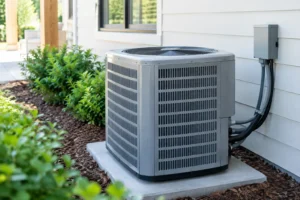
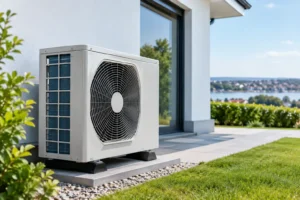
A split air conditioning system places the noisier outdoor unit outside and uses a slim indoor unit to cool the office. Modern systems can run quietly enough for focused work, while inverter technology adjusts output to maintain the chosen temperature rather than repeatedly switching on and off at full power. The result is steadier comfort and more efficient operation.
For many households, there is another practical advantage. Most quality split systems provide heating as well as cooling. This can make a home office comfortable on cold winter mornings without relying solely on an electric heater. It is particularly useful for garden rooms, loft conversions and spare rooms that tend to feel colder or warmer than the rest of the house.
The best aircon for home offices is usually a split system
A single-split system has one indoor unit connected to one outdoor condenser. For a dedicated home office, it is normally the most effective and cost-conscious option. It is discreet, reliable and gives independent control over the room, rather than forcing you to cool the whole property for the sake of one workspace.
Wall-mounted indoor units are the common choice because they distribute conditioned air efficiently from a high position and do not occupy desk or floor space. They also offer useful everyday controls, including timers, sleep settings, fan-speed adjustment and, on some models, app control.
A multi-split system may be the better route if you want air conditioning in a home office and one or more bedrooms. Several indoor units can connect to a single outdoor unit, reducing the number of condensers outside. However, this is not automatically the cheapest solution. The pipework, installation complexity and required capacity need to be assessed as a complete system.
Portable units have a place where permanent installation is not possible, such as a short-term rental or a temporary workspace. But for an owner-occupied home office used most weekdays, they are rarely the best long-term answer. Their lower upfront cost can be outweighed by greater noise, reduced efficiency and the inconvenience of fitting and removing an exhaust hose.
Get the capacity right, not just the biggest unit
Air conditioning capacity is often shown in kW or BTU. It is tempting to assume more capacity means better cooling, but an oversized unit can cool the room too quickly, cycle inefficiently and create uncomfortable draughts. An undersized unit may run continuously on hot days without ever bringing the room down to a comfortable temperature.
Room size matters, but it is only the starting point. A proper assessment also considers ceiling height, insulation, window area and orientation. A small south-facing office with large glazing may have a far greater heat gain than a larger, shaded room. Heat from computers, monitors, printers and occupants also adds up, especially in a compact office.
As a broad guide, many small home offices require a system in the region of 2.0 to 2.5 kW. Larger rooms, garden offices or spaces with significant solar gain may need more. This is not a specification to order from alone. A professional survey prevents costly guesswork and ensures the chosen unit performs when Essex experiences a genuinely hot spell, not only on a mild day.
Noise matters when your work involves calls
Noise level deserves as much attention as cooling output. A system can be technically quiet yet still feel intrusive if it is poorly positioned or constantly operating at a high fan speed because it is undersized.
Look for low sound-pressure figures for the indoor unit, particularly at its lowest fan setting. Quality wall-mounted models can operate at very low levels in quiet mode, which is useful for video meetings, recording, client calls and concentrated desk work. The outdoor unit should also be selected and located carefully to limit disturbance to neighbours and to avoid transferring vibration through a wall.
Placement is key. The indoor unit should not blow directly onto your chair, as constant cold air can become uncomfortable over a full working day. It also needs a clear path to circulate air across the room, rather than being boxed into shelving, fitted furniture or a corner above tall cupboards.
Efficiency, heating and running costs
The cheapest unit to buy is not always the most economical to own. Look at seasonal efficiency ratings, not only the headline price. A high-efficiency inverter system uses less energy once the room reaches temperature because it can reduce its output and hold a stable setting.
For a home office, a sensible temperature is usually around 21°C to 23°C in summer. Setting the unit far lower does not cool the room faster, but it can increase running costs and make the transition outdoors uncomfortable. Use a timer to pre-cool the room shortly before work begins, then allow the system to maintain the temperature rather than recover from intense afternoon heat.
If you plan to use heating mode, ask about the unit’s seasonal heating efficiency as well. Air-to-air heat pumps can provide efficient warmth, but performance and comfort depend on the selected system, outdoor conditions and the insulation of the office. A draughty garden room may benefit from improvements to insulation and glazing alongside air conditioning.
Installation details that affect performance
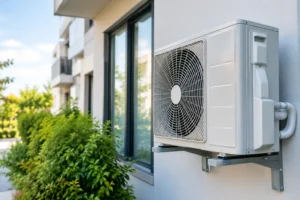
Professional installation is not simply about mounting an indoor unit on the wall. The installer must plan the refrigerant pipe route, condensate drainage, electrical supply and outdoor-unit location. Each decision affects appearance, reliability and future servicing.
Condensate from cooling mode needs to drain safely away. A gravity drain is often preferable where practical, although a condensate pump may be necessary in certain layouts. The outdoor unit requires sufficient airflow and service access, and it should sit on appropriate brackets or a solid base to control vibration.
Air conditioning systems containing refrigerant must be installed and commissioned by suitably qualified professionals. Correct pressure testing, evacuation and commissioning are essential to efficiency and system life. They are not details to leave to chance in pursuit of a lower quote.
It is also worth checking whether your property has any restrictions. Most straightforward domestic installations are possible without planning permission, but listed buildings, flats, leasehold properties and conservation areas can involve additional considerations. A survey is the right time to raise these points.
Features that genuinely help in a home office
Wi-Fi controls can be useful if your schedule changes or you want to start cooling before entering the room. Timers are often enough for predictable working hours, so choose the control option you will actually use rather than paying for features that add little value.
Air filtration can improve comfort by capturing larger airborne particles, but it should not be treated as a substitute for good ventilation. If a room feels stuffy during long workdays, the solution may involve ventilation, opening windows at suitable times or reviewing how the room is used. Air conditioning manages temperature very effectively; fresh-air requirements are a separate consideration.
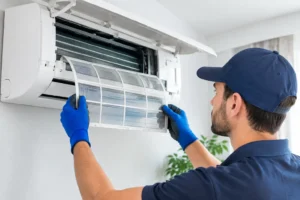
Swing controls are valuable because they help direct airflow away from your desk. Auto-clean or drying functions can also reduce moisture remaining inside the unit after cooling, although regular filter cleaning and planned maintenance are still needed.
Make the decision with a proper survey
The right system should fit your office, work pattern and property rather than a standard package. A survey allows the installer to assess heat gain, discuss unit location, explain likely pipe routes and provide a clear recommendation based on the way you work.
For homeowners across Essex, Essex Air Conditioning can provide that practical assessment before installation, with advice focused on capacity, comfort, efficiency and a neat finish. The aim is not to fill a room with the largest possible unit. It is to create a workspace that stays comfortable through summer heat and remains useful throughout the year.
A well-chosen air conditioning system should fade into the background once it is installed. You notice that the office is comfortable, your calls are clearer and the afternoon heat no longer dictates when you can work.