A rental property can look excellent at a viewing and still disappoint a tenant on the first humid night, when a top-floor bedroom will not cool down or a home office becomes uncomfortable by lunchtime. The right aircon features for landlords help prevent that problem without creating an expensive, difficult-to-manage system. The aim is not to buy the most complicated unit available. It is to specify dependable equipment that tenants can use easily, runs efficiently and can be maintained without disrupting the property.
For landlords in Essex, air conditioning is increasingly a practical improvement for modern flats, houses and rental offices. It can support comfort through warmer summers, provide efficient heating in the colder months and make a property more appealing. However, a good result depends on the features chosen, the system design and the quality of the installation.
The aircon features landlords should prioritise
Inverter technology for lower running costs
Inverter-driven air conditioning should be high on the list for almost every rental installation. Rather than repeatedly switching fully on and off, an inverter system adjusts its output to maintain the required temperature. That makes it quieter, more consistent and usually more economical to run than older fixed-speed equipment.
This matters where tenants pay their own electricity bills. A system that cools or heats efficiently is more likely to be used sensibly and valued as an asset rather than viewed as an expensive extra. It also reduces unnecessary strain on components, which can support reliability over the life of the system.
Efficiency ratings are useful, but they should not be assessed in isolation. A very efficient indoor unit will still perform poorly if it is undersized, badly positioned or serving a room with significant heat gain from large south-facing glazing. A professional survey should establish the actual cooling and heating demand before a system is specified.
Heating as well as cooling
Most modern split air conditioning systems are heat pumps, meaning they can provide both cooling and heating. For landlords, this is often one of the strongest reasons to install air conditioning rather than a cooling-only solution.
In a studio flat, converted loft or garden office, a wall-mounted unit can provide responsive warmth without waiting for a whole central heating system to raise the temperature. It can also give tenants a useful supplementary heat source in rooms that are naturally colder than the rest of the property.
That said, air conditioning should not be treated as a substitute for resolving insulation, draught or boiler issues. It works best as part of a well-maintained property, not as a workaround for wider building defects.
Simple controls with sensible limits
Tenants need controls that are straightforward from day one. A clear remote control, visible temperature setting and easy mode selection reduce avoidable call-outs caused by unfamiliarity. Systems with Wi-Fi control can be particularly useful, allowing occupants to cool a room before returning home or turn the heating on for a short period.
For a landlord, app control can have value after a change of tenancy or when a property is empty. However, it is worth considering who will hold access to the system and how account ownership will be transferred. Remote access should support management, not create uncertainty about privacy or control.
Some systems can apply set-point limits, preventing extreme temperature selections that drive up energy use. This can be helpful in managed accommodation or commercial lets, provided tenants are told clearly how the system is intended to be used. Settings should still allow comfortable operation. An overly restrictive system may simply create frustration.
Quiet operation protects the tenant experience
Noise is one of the most overlooked aircon features for landlords. A unit may have an impressive specification on paper but become a source of complaints if the indoor fan is intrusive in a bedroom or the outdoor condenser disturbs neighbours on a boundary wall.
Look for low indoor sound levels, especially in bedrooms, small lounges and home-working spaces. Variable fan speeds and night modes are useful because they reduce noise once the room has reached temperature. The position of the indoor unit is equally important. Airflow should not blow directly across a bed, desk or sofa, and the unit should be accessible for cleaning.
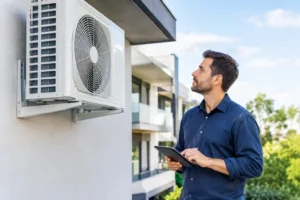
The outdoor unit needs the same care. Good mounting, vibration control and sensible siting make a noticeable difference. At flats and leasehold properties, landlords should also check whether there are freeholder, managing agent or planning considerations before work begins. A survey identifies practical constraints before equipment is ordered.
Filtration and dehumidification add everyday value
Standard filters protect the equipment and capture larger airborne particles. Higher-grade filtration or air-purifying functions can be useful in properties affected by road dust, pet hair or seasonal pollen, but they should not be oversold as a replacement for ventilation or medical treatment.
The more immediately valuable feature in many homes is dehumidification. Essex summers can bring warm, damp conditions that make rooms feel sticky even when the temperature is not especially high. Dry mode can improve comfort by removing excess moisture, often using less energy than full cooling.
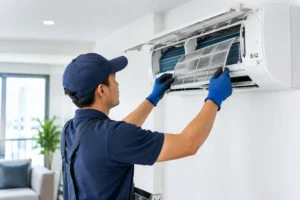
Landlords should explain that filters need regular cleaning. This is a small tenant responsibility that helps maintain airflow, reduces odours and avoids a decline in performance. Clear instructions at check-in can prevent what would otherwise become an unnecessary maintenance visit.
Multi-split or single-split: choose for the property
A single-split system connects one indoor unit to one outdoor unit. It is often the most reliable and cost-effective option for a key room, such as a principal bedroom, lounge, loft conversion or office. For many rental properties, solving the hottest or coldest room is enough to create a meaningful improvement in comfort.
A multi-split system connects several indoor units to one outdoor condenser. This can suit a house in multiple occupation, a larger family home or a small office where different rooms need independent control. It can also reduce the number of outdoor units required, which may be important where space is limited.
The trade-off is greater initial cost and more complex installation. A multi-split system is not automatically the best choice just because a property has several rooms. If only one room experiences regular overheating, a well-designed single split may deliver better value. The right approach depends on layout, occupancy, electrical capacity, outdoor space and the landlord’s budget.
Reliability starts with serviceable design
Premium equipment and professional installation are essential, but landlords should think beyond the day the system is fitted. A serviceable installation makes future maintenance quicker, safer and less disruptive between tenancies.
Indoor units should be positioned where filters, drain trays and electrical components can be accessed. Condensate drainage must be designed correctly to avoid leaks and staining. Outdoor units should have adequate airflow around them and enough clearance for an engineer to inspect and service them.
A reputable installation will also include proper pipework insulation, secure fixings, electrical protection and commissioning. These are not optional extras. They directly affect efficiency, noise levels and the likelihood of future faults.
Maintenance features are only useful with a plan
Many modern systems include filter reminders, self-cleaning cycles and fault codes. These can help, but they do not remove the need for professional maintenance. Regular servicing checks refrigerant circuit condition, electrical connections, drainage, coil cleanliness and overall operation before minor issues develop into a breakdown.
For a single domestic unit, an annual check is usually a sensible approach, particularly where it is used for both heating and cooling. Higher-use rental properties, offices and multi-unit systems may need more frequent attention. Keep service records alongside other property maintenance documentation, and make sure tenants know how to report a fault promptly rather than continuing to run a poorly performing unit.
Specify the system around the tenancy, not the brochure
The best system for a short-let studio will not necessarily suit a long-term family tenancy or a small commercial premises. Consider how rooms are used, whether occupants work from home, where heat builds up, how electricity costs are managed and how easily engineers can gain access.
A free on-site survey is the point at which these details become clear. Essex Air Conditioning can assess the property, discuss the balance between upfront cost and long-term performance, and recommend equipment that fits the building rather than forcing a standard package into it.
A well-specified air conditioning system should quietly make a tenancy easier: comfortable rooms, predictable running costs and fewer preventable maintenance problems. That is the kind of feature tenants remember when they decide whether to stay.