A small office can feel stuffy long before anyone says so. Concentration drops, the meeting room feels close by mid-afternoon, and dust seems to settle again as soon as it has been cleaned. These are practical signs that air filtration for small offices deserves attention, particularly in busy workplaces with limited opening windows, roadside locations or several people sharing a compact space.
A good solution is not simply a matter of buying the biggest air purifier available. The right approach considers how the room is used, how fresh air enters the building, what pollutants are likely to be present and whether the existing air conditioning or ventilation system can do more of the work. For small businesses, the aim is straightforward: cleaner, more comfortable air without unnecessary running costs or disruption.
Why small offices need a considered approach
Small offices often have a high number of people for their floor area. A converted room, independent practice, studio or compact commercial unit may house several staff members, visitors and equipment throughout the day. Computers, printers, cleaning products, outdoor traffic pollution and ordinary everyday dust all add to the airborne mix.
Carbon dioxide is another consideration. It is not something a standard air purifier removes, but it can build up where fresh-air ventilation is poor. Higher levels are commonly associated with a stuffy feeling and reduced alertness. This is why filtration and ventilation should work together rather than being treated as alternatives.
In Essex, offices close to busy roads or commercial areas may also be reluctant to leave windows open for long periods because of noise, fumes, security or cold weather. Mechanical ventilation, well-maintained air conditioning and suitable filtration can provide a more reliable answer than relying on open windows alone.
Air filtration for small offices starts with the source
Before selecting equipment, look at what is affecting the air in the first place. There is little value in adding filtration while a damp problem, a dirty ventilation duct, a poorly maintained unit or an unsuitable cleaning routine continues to introduce contaminants.
A brief site assessment should consider the number of regular occupants, room sizes, ceiling height, window use, printer and kitchen areas, external pollution and the condition of any existing HVAC equipment. It should also identify spaces that create particular problems, such as enclosed meeting rooms, reception areas or rooms used by staff with allergies.
This assessment matters because a small air purifier may be perfectly adequate for a private office but insufficient for an open-plan workspace. Equally, installing a powerful unit in a very quiet consulting room can create unwanted noise if it must run at a high fan speed to keep up.
Filtration is not the same as ventilation
Filtration removes particles from air that passes through a filter. Depending on the filter type, this may include dust, pollen, fine particulate matter and some airborne particles associated with smoke. Ventilation replaces stale indoor air with fresh outdoor air or, in some systems, treated supply air.
Neither does the other job completely. A portable air cleaner with a high-efficiency particle filter can improve particulate levels in a room, but it will not provide fresh oxygen-rich air or control carbon dioxide. Opening a window may improve fresh-air supply, but it can also bring in pollen, traffic pollution or cold air.
For many small offices, the most effective arrangement is balanced: adequate fresh-air provision, sensible control of pollutants at source and filtration where it provides a clear benefit.
Choosing the right filter and equipment
Filter performance should be judged by what the office needs to remove, not by marketing claims alone. A quality particulate filter is usually the priority for general office dust, pollen and outdoor particulate pollution. Where odours or certain gaseous pollutants are a concern, activated carbon can help, although its effectiveness depends on the amount of carbon used and how often it is replaced.
High-efficiency particulate filters can capture very fine particles, but they may restrict airflow if fitted to a system not designed for them. That can increase fan energy use, reduce system performance and place extra strain on equipment. The filter needs to be compatible with the air handling unit, fan capacity and ductwork.
For a portable unit, capacity is critical. Check the clean air delivery rate against the size of the room, and allow for real-world conditions such as people moving in and out, doors opening and local pollution. A unit that is correctly sized can run at a quieter, lower setting for much of the day. One that is undersized will often be noisy and ineffective.
Look for practical features too: clear filter-change indicators, a realistic replacement filter cost, a low-noise setting and controls that staff can use without constantly adjusting. A complicated solution is unlikely to be operated properly over time.
Make existing air conditioning work harder
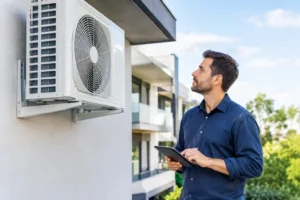
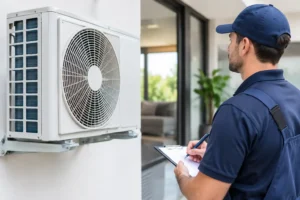
Many small offices already have wall-mounted air conditioning units, ceiling cassettes or ventilation equipment. These systems may provide cooling and heating effectively while receiving little attention between breakdowns. Regular maintenance can make a meaningful difference to air quality as well as comfort and energy consumption.
Dirty filters, blocked coils and poorly maintained condensate systems can reduce airflow and create unpleasant odours. In some cases, a system may be recirculating air efficiently but introducing very little fresh air. An experienced HVAC technician can assess what the current system does, what it does not do and whether upgrades are worthwhile.
Possible improvements may include using an appropriate higher-grade filter where the system permits it, improving outdoor-air settings, adding local extraction in kitchen or print areas, or supplementing a problem room with a correctly sized portable air cleaner. The right answer depends on the building. There is no single filter specification that suits every small office.
Do not overlook airflow and placement
Even excellent filtration performs poorly when air cannot reach it. Portable cleaners should not be hidden behind desks, placed tight against walls or blocked by filing cabinets. Position them where air can circulate freely, away from obvious obstructions and without directing a strong draught at an employee’s desk.
Air conditioning vents also need clear paths. Furniture layouts can unintentionally block supply or return air, leaving one part of the room warm, dusty or stale while another is overcooled. During an office review, it is worth checking whether comfort complaints follow a pattern. They often reveal an airflow issue rather than a need for more cooling capacity.
Maintenance protects performance and value
Filters do not last indefinitely. Their service life depends on outdoor air quality, occupancy, operating hours and the level of dust in the office. Waiting until a filter is visibly dirty can be too late, as airflow may already have fallen and the system may be using more energy than necessary.
A planned maintenance schedule gives office managers a clearer picture of filter condition, refrigerant system performance, drainage, electrical components and general cleanliness. It also prevents the common cycle of ignoring equipment until a warm day exposes a fault.
Staff can support this process with simple habits: keeping vents clear, reporting unusual smells or noises promptly, avoiding heavy aerosol use near indoor units and not switching off ventilation solely to reduce noise. If the office has a portable air cleaner, someone should be responsible for checking its indicator light and ordering replacement filters before they are needed.
When to arrange a professional survey
A professional survey is particularly useful if staff regularly complain of stuffiness, recurring odours, uneven temperatures or excessive dust. It is also sensible before fitting higher-efficiency filters to an existing system, adding air cleaning equipment across several rooms or planning a new office layout.
For business owners in Essex, an on-site assessment provides a practical way to match the solution to the premises rather than guessing from room measurements alone. Essex Air Conditioning can assess existing cooling and ventilation equipment, explain suitable options clearly and provide a no-obligation quote for work that will genuinely improve the space.
Cleaner office air should not be an afterthought or a costly experiment. Start with how the space is used, make sure fresh-air provision is adequate and choose filtration that the system can support. With the right design and regular care, a small office can remain a place where staff and visitors are comfortable from the first hour to the last.